
How to Read the Bible When You’re Busy: A Rhythm That Survives a Real Week

Most advice about how to read the Bible when you’re busy is built for a life you don’t currently have.
It’s 9:40 on a Tuesday night. The dishwasher is running, one kid still isn’t in bed, and the alarm is set for 5:45 because of a drive you’d rather not make. You open the app on your phone. It tells you you’re nineteen days behind. You look at the number for a second and close it again.
If you’re trying to work out how to read the Bible when you’re busy, the most useful thing to say first is that the number on that screen isn’t a moral report card. It’s a design failure. You picked up a plan built for a life you aren’t living, and it broke the way it was always going to break.
The plan failed. That’s a different sentence than the one you’ve been telling yourself.
What a Reading Rhythm Actually Is
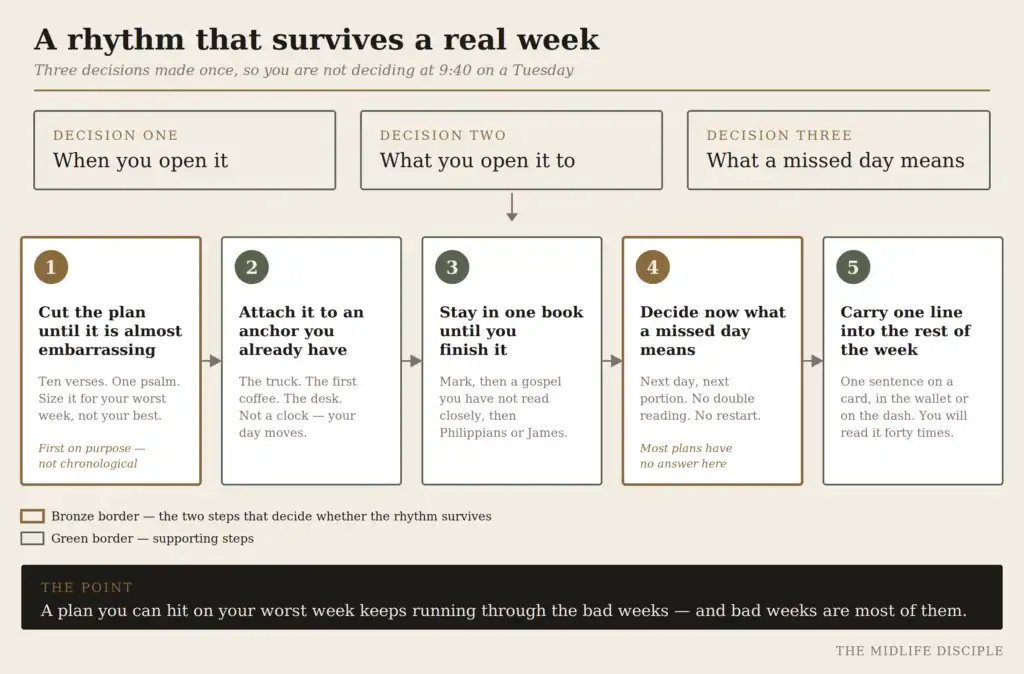
A rhythm is three decisions made once, in advance, so you don’t have to make them at 9:40 on a Tuesday: when you open it, what you open it to, and what happens when you miss.
That’s it. There’s no fourth part.
It’s worth naming what a rhythm isn’t, because the thing most men are actually failing at is a convention rather than a command. The “quiet time” — a solo appointment, thirty minutes, coffee, dawn, journal open — is a particular practice from a particular slice of church culture. It’s a good practice. Plenty of men have been well fed by it for decades. But Scripture doesn’t prescribe that format, and a man who can’t make it work hasn’t discovered anything about his character.
What the text describes looks looser and more woven-in than that. Moses, giving Israel their instructions before they crossed the Jordan, put it like this:
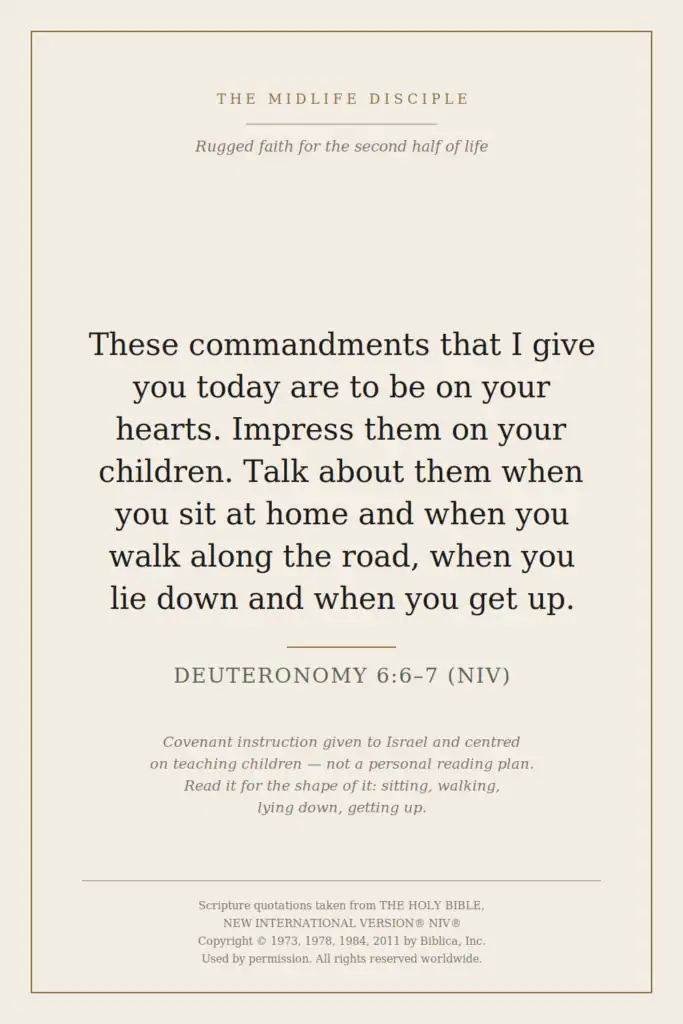
These commandments that I give you today are to be on your hearts. Impress them on your children. Talk about them when you sit at home and when you walk along the road, when you lie down and when you get up. — Deuteronomy 6:6–7 (NIV)

Read it for what it is. That’s covenant instruction to a nation, addressed to households and centered on teaching children — not a personal reading plan, and it shouldn’t be flattened into one. But the shape of it is worth noticing. Sitting, walking, lying down, getting up. It assumes the words are moving through an ordinary day rather than sitting in a thirty-minute slot at the front of it.
Psalm 1 describes the same saturation from another angle — a man who meditates on his law day and night (Psalm 1:2, NIV). That’s wisdom poetry contrasting two ways of living, not a productivity target. But “day and night” is not the language of an appointment.
That distinction matters for a man with no margin. If the format is the command, a full life disqualifies you. If the format is a convention, then the question isn’t whether you can find thirty clean minutes. It’s what a rhythm looks like inside the week you already have.
Why This Is Worth the Trouble
Here’s the honest version of the case.
Paul’s line to Timothy is that All Scripture is God-breathed and is useful for teaching, rebuking, correcting and training in righteousness, so that the servant of God may be thoroughly equipped for every good work (2 Timothy 3:16–17, NIV). Useful. Training. Equipped. It’s the vocabulary of a long apprenticeship, not a lightning strike.
Which sets expectations correctly:
- It works slowly, the way conditioning works. You don’t feel the fifteenth session.
- It changes what occurs to you — the sentence that surfaces in an argument with your wife, or on a drive home after a conversation you handled badly.
- It gives you something outside your own head. At forty-five, most of what’s in there is on a loop.
It is not a technique for making yourself feel better on a hard week, and it will disappoint you if you use it as one.
And here’s what it won’t do. It won’t fix your marriage, retire your debt, straighten out a kid who’s drifting, or make you sleep. Anyone selling reading as the lever that moves those is selling something. If a stretch of consistent reading coincides with things improving, that’s worth being grateful for, not a formula you can run again.
One thing to be straight about before the steps: what follows is put together from what the practice demands and what men who’ve sustained it consistently report — not from a system I’ve run successfully for years. I don’t have one to hand you. Take it as observation, and test it against your own week rather than mine.
How to Read the Bible When You’re Busy: Five Steps
They’re not in chronological order. The first one prevents the failure that kills every other attempt, so it goes first even though it feels like an afterthought.
- Cut the plan until it’s almost embarrassing
- Attach it to something you already do without deciding
- Stay in one book until you finish it
- Decide now what a missed day means
- Carry one line into the rest of the week
1. Cut the plan until it’s almost embarrassing
Nearly every failed attempt at daily Bible reading starts with a plan sized for the man you intend to become rather than the one who exists on a Wednesday in February.
So cut it. Not to a level you can manage on a good week — to a level you could hit on the worst week you’ve had this year. Ten verses. One psalm. Half a chapter. If the number sounds too small to matter, it’s close to right.
The reason isn’t motivational. It’s that a plan you can hit on a bad week keeps running through the bad weeks, and bad weeks are most of them. A plan sized for your best self stops the first time life is normal, and stopping is the only real failure mode here. Everything else is just a slower pace.
You can always read more on a morning when there’s room. Nobody’s stopping you. The floor is the thing you’re defending, and the floor should be low enough that defending it is boring.
2. Attach it to something you already do without deciding
Don’t schedule it against a clock. Attach it to an existing anchor — something that already happens every day whether you’ve decided anything or not.
The truck before you turn the key. The first coffee, before the phone. Sitting down at your desk. Lunch, in the cab, with the door shut.
The clock is a bad anchor because your day moves. The anchor works because it’s already load-bearing.
This isn’t a spiritual principle, and it isn’t mine. It’s the plainest finding in the behavioral research on why intentions don’t become actions. Gollwitzer and Sheeran’s meta-analysis of 94 independent tests found that specifying when and where in advance — if I’m in situation Y, then I do X — produced a medium-to-large effect on whether people actually did the thing. Intending to read more isn’t a plan. “In the truck, before the key” is.
Practically: put the book where the anchor is. A physical copy in the truck door, on the nightstand, in the bag. This is a small thing that does more work than it should, because the phone is where every other demand on your attention also lives, and opening a Bible app means walking past all of them.

3. Stay in one book until you finish it
Pick one book. Read it start to finish. Then pick another.
Whole-Bible-in-a-year plans have a well-known structural problem: they front-load Genesis, which reads fine, then land you in Leviticus around the second week of February with no context and no momentum. Most men who quit a reading plan quit somewhere in there, and they quit thinking the problem was them.
Staying in one book solves several things at once. You stop spending your attention on where you are. Yesterday’s reading is context for today’s. And you start noticing an argument develop, which is what most of these books are actually doing.
If you want a starting point: Mark, because it moves. Then a gospel you haven’t read closely. Then something short from the letters — Philippians, or James, which is blunt in a way that tends to land with men who are tired of being handled.
4. Decide now what a missed day means
This is the step nobody plans for, and it’s the one that ends most attempts.
Write it down somewhere: a missed day means I read the next day’s portion the next day. Not a double portion. Not a catch-up week. Not a restart on the first of the month. You pick up where you are.
The reason to decide this in advance is that you won’t decide it well in the moment. In the moment, a missed day becomes three, three becomes a background sense that you’ve failed at something, and that feeling is what makes a man avoid opening the book at all. The avoidance does far more damage than the missed day did.

Nothing in the text ties God’s regard for you to a streak. If a reading plan has started functioning as a scoreboard for whether you’re a good man, the plan is doing something it was never meant to do, and it’s worth putting down for a week on purpose just to break the association.
5. Carry one line into the rest of the week
Reading is where it starts. What actually moves is what stays with you afterward.
Practically: at the end of the reading, pick one sentence. Not the most impressive one — the one that snagged. Write it on an index card, put it in your wallet or on the dash, and leave it there for the week. You’ll read it forty times without trying.

This is the part that gets closest to what Deuteronomy 6 describes — the words moving through the sitting and walking and lying down. And it’s the part that fits a full life best, because it costs nothing. You’re not finding more time. You’re using time that already exists, in the truck and the checkout line and the ten minutes before sleep.
What Usually Goes Wrong
Reading to finish rather than to hear. The plan becomes a task with a completion state, and you find you’ve read four chapters and retained nothing. If you catch yourself skimming to be done, stop and reread three verses slowly. The point was never the chapter count.
Starting over on the first of the month. The restart feels like commitment. It’s usually avoidance wearing better clothes, because a restart is a fresh streak, and a fresh streak is the thing that broke last time.
Doing it on the phone. For some men this is fine. For most it isn’t, because the device is a portal to everything else and the notification arrives mid-sentence. If you’ve tried and it hasn’t held, a paper copy isn’t nostalgia. It’s removing a variable.
Waiting for things to calm down. They won’t, and this is the specific lie that costs men years. Forty to sixty is not a runway to something quieter. Kids get more expensive, parents get older, the job doesn’t ease off. The week you’re waiting for isn’t coming, and the ten verses are available now.
Confusing the rhythm with the relationship. A man can read every day for a year and stay exactly where he was. Reading is a means, and a good one. It isn’t the thing itself.
How to Read the Bible When You’re Busy If Your Week Doesn’t Look Like Anyone Else’s
Some of this genuinely doesn’t suit some lives, and the honest move is to say so rather than tell you to try harder.
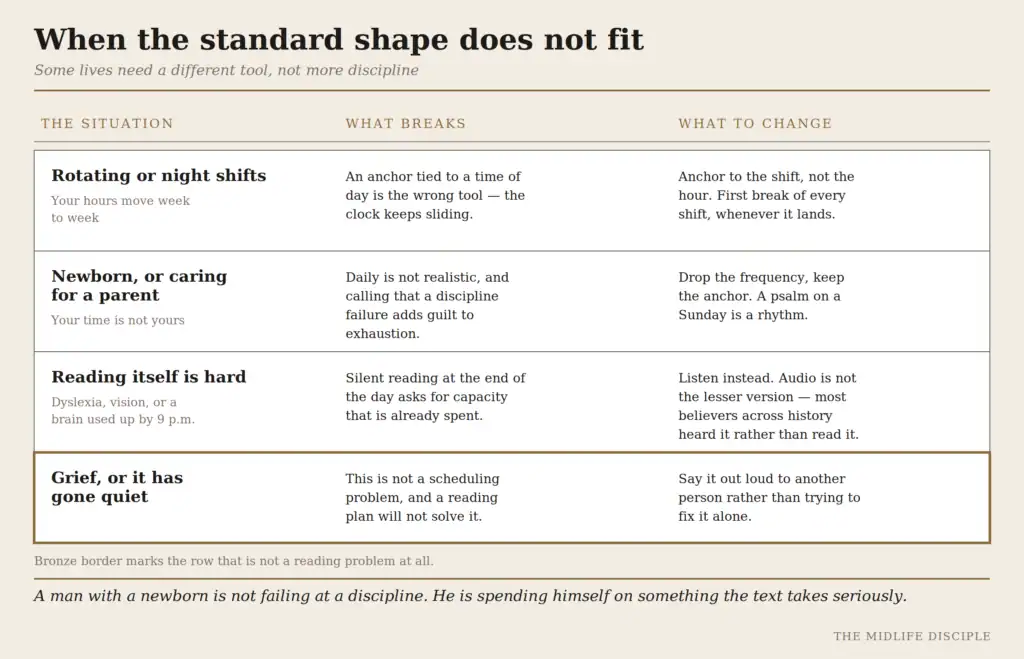
If you work nights or rotating shifts, a daily anchor tied to a time of day is the wrong tool. Anchor it to a shift instead of a clock — the first break of every shift, whatever hour that lands on.
If you’re in the first months with a newborn, or you’re the one handling a parent’s care, you’re not failing at a discipline. You’re spending yourself on something the text takes seriously. A psalm on a Sunday is a rhythm.
If reading is hard for you — dyslexia, vision, or just a brain that’s used up by 9 p.m. — listen instead. Audio is not the lesser version. For most of the history of the church, most believers encountered Scripture by hearing it, and the men in Deuteronomy 6 are talking, not reading silently.
If you’re in grief, or a stretch where the whole thing has gone quiet and reading feels like talking to a wall — that’s a different problem than a scheduling one, and a reading plan won’t solve it. Worth saying to somebody out loud rather than trying to fix alone.
How to Read the Bible When You’re Busy: Questions Men Actually Ask
How long should I read for? Long enough to be honest, short enough to be repeatable. Ten to fifteen minutes is plenty. The length matters far less than whether it survives a bad week.
Is morning actually better? It’s better for some men and it’s a convention, not a command. The advantage is that mornings get hijacked less often. If yours are chaos and your evenings are calm, read at night.
Which translation should I use? One you’ll actually read. TMD quotes the NIV. If a passage lands strangely, setting it beside another translation is a reasonable thing to do — that’s different from picking whichever rendering suits the point you want.
What if I don’t understand what I’m reading? Normal, and not a disqualification. Keep a running list of questions rather than stopping to solve each one — most resolve as you read further into the same book, and a study Bible’s footnotes handle much of the rest.
Does listening count? Yes. It’s not a workaround. Most Bible apps, including YouVersion, carry audio for every book.
Can ten verses a day really be enough? Enough for what, is the question underneath that. Ten verses a day is roughly three times through the New Testament in a year, which is not nothing. But the case for the small number isn’t volume — it’s that it keeps running.
I’ve been at this for months and feel nothing. Is it working? Possibly, and feeling isn’t the instrument. The 2 Timothy language is about being equipped over time, which is not a thing you feel happening. That said, if “nothing” has become a heaviness that follows you around, that’s worth taking to a person rather than solving with a better plan.
More From The Mid Life Disciple
- Wilderness Reset: The Brutal Truth for Men Over 40
- The Armor of God Mental Health Guide: Why Your Mind Needs Armor, Too
- Why Christian Discipline Is a Spiritual Skill for Men
Wrapping Up
Most of what’s written about how to read the Bible when you’re busy opens by telling you that you aren’t really busy, you’re just poorly prioritized. Set that aside. You know what’s in your week. The question isn’t whether you’re serious; it’s whether the thing you picked up was ever built for the life you actually have.
So build the small version. Tonight, before you sleep: pick the anchor — the truck, the coffee, the desk — and put a physical Bible there. Tomorrow, at the anchor, read the first ten verses of Mark. When you’re done, write one line on a card and put it in your wallet.
That’s the whole thing. It’s not impressive, and it will still be running in March.
Scripture quotations taken from The Holy Bible, New International Version® NIV®. Copyright © 1973, 1978, 1984, 2011 by Biblica, Inc.™ Used by permission. All rights reserved worldwide.