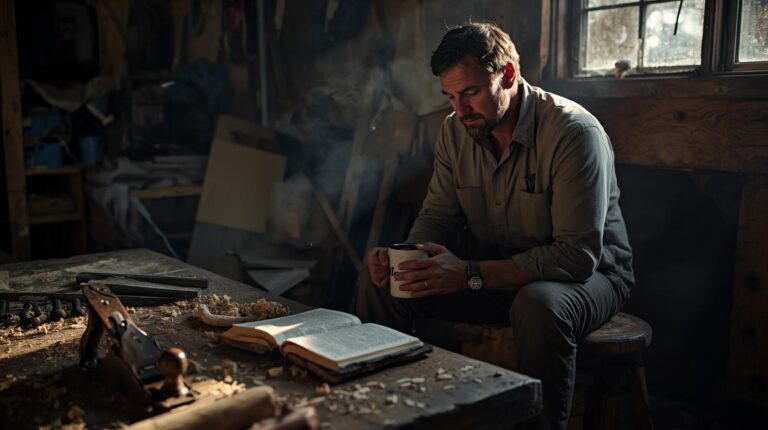
When you are learning the true meaning of faith and craftsmanship, there is a specific, heart-stopping moment in every single woodworking project I have tackled in the last twenty years where I face a choice. It’s usually about 11:30 PM. My back hurts, my eyes are full of dust, and I just realized I cut a tenon an eighth of an inch too short.
Do I do it right? Or do I do it fast?
Every man who has ever held a board and a tape measure knows this tension. You can eyeball it. You can skip the sanding (because who looks at the underside of a table, right?). You can use cheaper wood, cheaper screws, and fill the gaps with sawdust and glue, calling it “rustic charm.”
But deep down, in that place where your conscience and your pride wrestle, you already know the ending. Wobbly legs. Warped surfaces. Regret. And somewhere between sweeping sawdust and muttering under your breath about how much you hate pine, it hits you:
This is exactly how life works.
Cheap Wood Builds Cheap Lives
I once built a small bench using leftover scrap because I was too cheap to go to the lumber yard. It had knots everywhere. The grain was twisted like a pretzel. My measurements were, shall we say, “aspirational.”
I told myself that faith and craftsmanship were about the heart, not the precision, which is a convenient lie we tell ourselves when we are lazy. It looked fine… for about a week.
Then the wobble started. Then the crack. Then the slow, humiliating realization that shortcuts always invoice you later—usually with interest. That bench preached a sermon better than most pastors I know: You can fake strength for a season, but weakness always reveals itself.
God cares how you build your life for the same reason I now care how I build furniture. Because structure matters. If you ignore the principles of faith and craftsmanship, gravity and time will eventually expose you.
Jesus Was a Carpenter (And He Probably Hated Shortcuts)
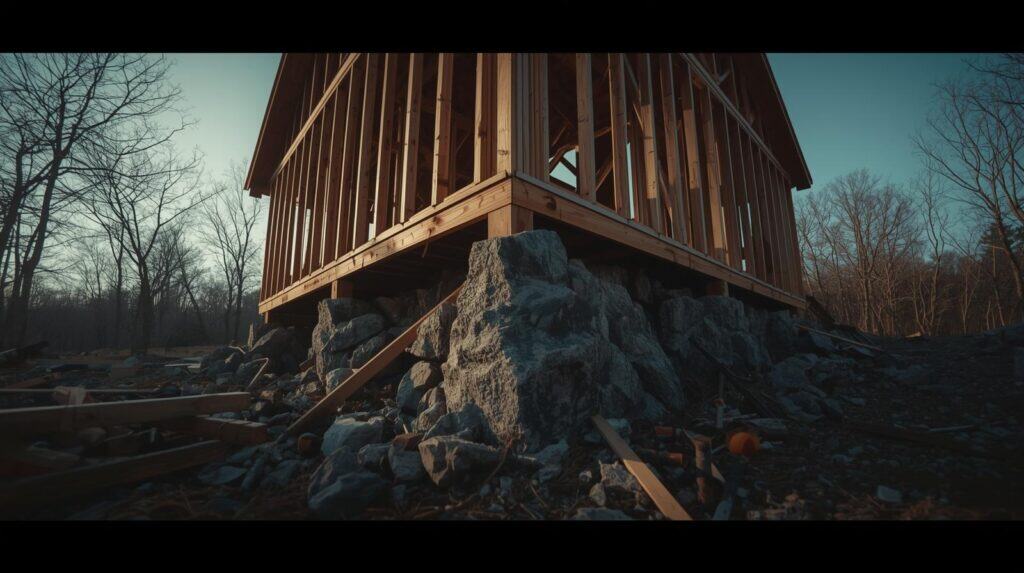
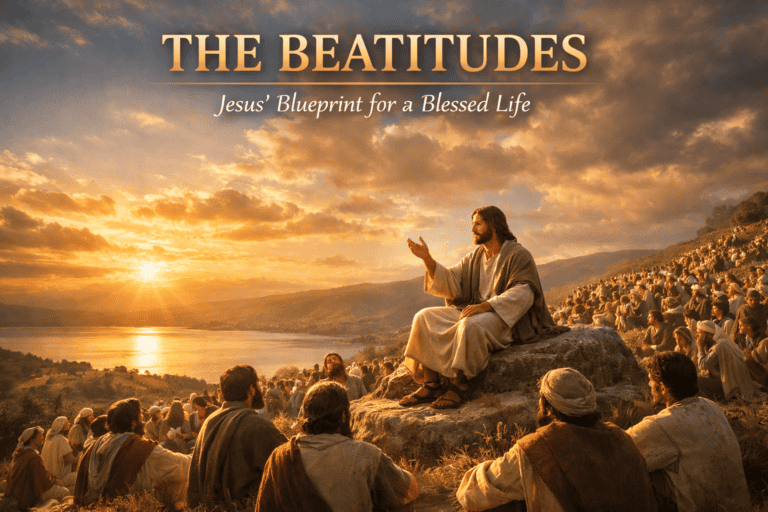
We love to romanticize Jesus as a carpenter, but we rarely think about what that actually means. In Matthew 7:24–27, Jesus drops the ultimate faith and craftsmanship analogy.
“Everyone who hears these words of mine and puts them into practice is like a wise man who built his house on the rock.”
Jesus didn’t say, “Everyone who listens to my podcast is smart.” He said everyone who puts them into practice. That is the essence of faith and craftsmanship. It is the practical application of theory.
Storms don’t ask if your foundation is solid. They don’t care if you meant well. They just show up. Marriage trouble. Health scares. Job loss. That midlife confusion where you buy a sports car or start a podcast.
If your life is built on comfort, approval, money, or distraction, it holds… until it doesn’t. When I look at the intersection of faith and craftsmanship, I realize that theology is just the blueprint. Your actions are the bricks. If you aren’t laying them straight, the whole thing comes down when the wind blows.
Integrity Is Structural, Not Decorative
We live in a world obsessed with veneers. We love surface upgrades. A new truck. A new job title. A new “season” of life (whatever that means). But God is focused on the frame.
1 Corinthians 3:10–15 reminds us: “Each one should build with care.” Notice it doesn’t say decorate with care. It says build.
In the world of faith and craftsmanship, integrity is your joinery. You can use pocket holes if you want—they are fast and easy—but they aren’t meant to hold up a dining table that seats twelve. A mortise and tenon joint, however, is hidden. Nobody sees it. It takes three times as long to cut. It requires sharp chisels and patience. But it holds.
Character is what holds weight when no one is watching.
- How you speak when you’re angry.
- What you do when nobody knows.
- Who you become when life strips everything else away.
That’s the real structure. Everything else is just trim work and paint. True faith and craftsmanship demands that we pay more attention to the things nobody sees than the things everybody likes on Instagram.
Wood Movement and Spiritual Rigidity
Here is a technical truth I learned the hard way: Wood moves. It expands in the summer humidity and shrinks in the winter dry spells. If you bolt a tabletop down too tight without allowing for movement, it will crack. It will literally tear itself apart.
This is a massive lesson in faith and craftsmanship. I see so many guys trying to build a life that is rigid. They think faith means having zero doubts, zero flexibility, and zero room for error. But that’s not strength; that’s brittleness.
Real faith and craftsmanship accounts for the seasons. It allows for the expansion of grace and the contraction of discipline. If you try to constrain your life too tightly with legalism or control, you’re going to split down the middle the moment the atmosphere changes.
I recall reading an article on Fine Woodworking about breadboard ends—a technique specifically designed to keep a table flat while allowing it to breathe. We need spiritual breadboard ends. We need a theology that keeps us flat and true but allows us to breathe when life gets humid and heavy.
Midlife Is Renovation Season
Here’s the gift no one tells you about turning 50: You finally see the cracks.
When I was 25, I thought I was built out of solid oak. Turns out, I was mostly particle board with a nice veneer. Midlife exposes the bad habits, the compromises you justified, and the faith you postponed.
But here is the beauty of faith and craftsmanship: Midlife isn’t a crisis; it’s an inspection.
God walks through your life like a master builder. He taps on the drywall. He checks the load-bearing beams. He says, “This beam needs replacing. It’s got dry rot.”
He isn’t doing it to shame you. He’s doing it to strengthen you. This is the core of faith and craftsmanship. It is the willingness to let the Master Builder tear out the rot so the house doesn’t collapse. You’re not being torn down; you’re being remodeled.
I’ve had to sand out some deep scratches in my character over the last few years. And let me tell you, sanding is boring. It’s repetitive. It makes a mess. But you cannot apply the finish until the surface is prepped. Faith and craftsmanship require you to embrace the grit.
The Tools of the Trade
If we are going to talk about faith and craftsmanship, we have to talk about tools. You cannot build a cathedral with a plastic screwdriver.
I have spent a small fortune on tools. Some were necessary (table saw), some were vanity purchases (looking at you, laser-guided miter saw), and some were total waste. But in the spiritual realm, your tools are your habits.
Prayer is a clamp. It holds things together while the glue sets. If you take the clamps off too early—if you stop praying the moment the crisis fades—the joint fails. That is a fundamental law of faith and craftsmanship.
Scripture is your square. You might think you are building at a 90-degree angle, but your eyes will deceive you. You need an external standard to reference. Without it, you are building a leaning tower of Pisa and calling it architecture.
Community is your sandpaper. It rubs you the wrong way. It’s abrasive. It heats you up. But it is the only way to get the rough edges off. You can’t smooth yourself. You need friction. That is the communal aspect of faith and craftsmanship.
What Are You Building On Right Now?
Let’s get real. Ask yourself, man to man: Is my faith a foundation… or just a decoration? Am I building for approval… or obedience? If a storm hit tomorrow, what would collapse first?
You already know the answers. You know where the wobble is. You know which leg is short.
And here’s the grace that comes with faith and craftsmanship: You can start rebuilding today. You don’t have to bulldoze the whole house (usually). Sometimes, you just need to shore up a joist.
One prayer. One habit. One honest decision to stop lying to yourself.
Strong lives aren’t built in a day. They’re built daily. That is the mantra of faith and craftsmanship. It is the slow, steady accumulation of right choices.
Final Cut
God cares how you build because He plans for you to last. He isn’t interested in flipping a house. He wants a heritage piece.
He doesn’t want you to just survive or scrape by. He wants you to stand. Like a table that doesn’t wobble when you slam your fist on it. Like a house that doesn’t shake when the thunder rolls. Like a man who knows what he’s built on.
This is the ultimate goal of faith and craftsmanship. To be built by faith, tested by life, and still standing.
The world is full of cheap furniture. Be the thing that lasts.
If you are interested in diving deeper into the history of how faith and building have intersected, check out this history of carpentry. It puts our modern struggle into perspective. Furthermore, if you feel your foundation cracking, don’t hesitate to seek professional help—sometimes faith and craftsmanship means calling in a subcontractor, like a counselor. Resources like Focus on the Family can be a good place to start looking for blueprints.
Remember, faith and craftsmanship isn’t a hobby. It’s a survival strategy.
FAQ: Faith and Craftsmanship
Q: Why do you combine faith and craftsmanship in your writing? A: Because they are the same thing. Both require patience, planning, vision, and the ability to deal with mistakes. Faith and craftsmanship are both about bringing something orderly and beautiful out of raw, chaotic materials. Whether it’s a rough-sawn board or a rough patch in life, the process of refining is identical.
Q: I’m not a woodworker. Does this apply to me? A: Absolutely. You might not build tables, but you are building a life, a family, or a career. The principles of faith and craftsmanship—measuring twice, building on a solid foundation, and finishing strong—apply to accounting, parenting, and even gardening.
Q: What is the biggest enemy of faith and craftsmanship? A: Hurry. Hurry kills projects, and hurry kills souls. In woodworking, rushing leads to tear-out and injury. In faith, rushing leads to shallow theology and burnout. Faith and craftsmanship both demand a slowing down of time.
Q: Can you really find spiritual lessons in power tools? A: You’d be surprised. A table saw teaches you about respect and boundaries. A router teaches you that direction matters (go against the grain, and you’ll have a disaster). Faith and craftsmanship are everywhere if you have the eyes to see the sawdust parables.
Q: How do I start rebuilding if my foundation is cracked? A: Start small. Don’t try to renovate the whole house in a weekend. Pick one area—your anger, your prayer life, your marriage—and apply the principles of faith and craftsmanship there first. Consistency beats intensity every time.
Q: Where can I learn more about the biblical view of work? A: I recommend reading up on the “Theology of Work.” There are great resources at Theology of Work Project that explain how our daily labor connects to God’s plan. It’s a deep dive into faith and craftsmanship.