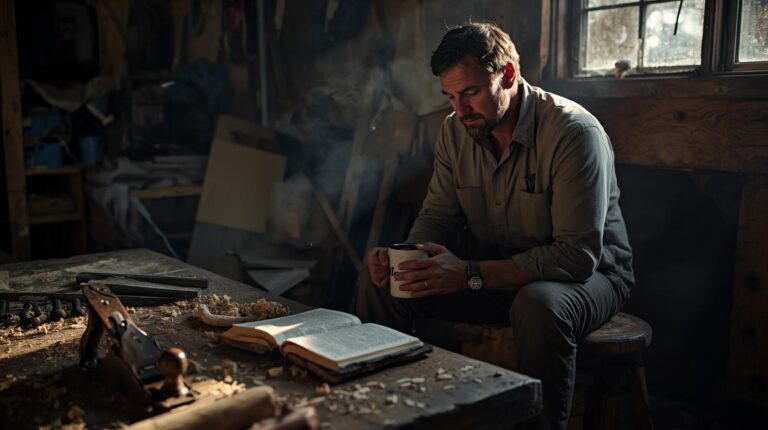
Spiritual Winter: Stop Digging Up Your Seeds
“For everything there is a season, and a time for every matter under heaven: a time to be born, and a time to die; a time to plant, and a time to pluck up what is planted.”
— Ecclesiastes 3:1–2
The View from the Window
I am looking out my window in Mena, Arkansas, and I have to tell you: it looks absolutely miserable out there.
Winter has the final word this morning. The garden beds, which I labor over with an obsessive degree of affection during the spring, currently look like soggy cardboard that’s been left out in the rain for a month. The trees are standing there naked, shivering, looking frankly embarrassing, with their branches clawing at a gray sky that refuses to offer even a hint of sunshine.
There is no birdsong. There are no blooms. There is absolutely no movement. It is the kind of stillness that makes you check your pulse just to make sure you haven’t accidentally expired while drinking your coffee.
To an outsider—perhaps one of you city slickers who thinks strawberries are manufactured in the back room of a Whole Foods—it looks like death. It looks like a failure.
And honestly? I get it. I really do. We live in a culture that has trained us, like Pavlov’s dogs, to believe that if nothing visible is happening, then nothing is happening at all. We are addicted to the perpetual harvest.
- We want quarterly growth charts that go up and to the right, forever.
- We want spiritual mountaintop experiences every Sunday morning before brunch.
- We want bodies that defy the laws of thermodynamics and never age.
- We want businesses that never stall, bank accounts that never dip, and children who never need braces.
Basically, we want July tomatoes in January weather. And when we don’t get them, we throw a tantrum.
But I’ll admit something to you, just between us. I hate the waiting. I am not a patient man. I preach patience, sure, because it’s in the job description, but practicing it? That’s for other, holier people. I want to be out there right now, sinking my hands into the dirt and shoving tomato plants into the soil. I want progress. I want evidence that I am not wasting my time. I want momentum.
But I also know better. I have been gardening long enough to know that if I give in to my impatience and plant today, the frost will kill everything I love. Impatience doesn’t speed up spring; it just guarantees you’ll be buying new plants in April. It guarantees loss.
And that, my friends, is the first hard lesson of a Spiritual Winter.
The Myth of Inactivity

Let’s talk about what winter actually is, biologically speaking, because most of you seem to think it’s just “the time when plants die.”
Winter is not death. Winter is preparation.
While those branches out there look lifeless, the roots are actually working harder than they do in July. They are deepening. They are strengthening. They are spreading underground in the dark, where no one can see them and no one can applaud them on Instagram. This is the Spiritual Winter of the plant world. Without this period of dormancy, the plant exhausts itself.
The soil is doing something holy, too. It’s resting. It’s rebalancing its nutrients. It is healing from the absolute exhaustion I put it through last season when I demanded it produce 400 pounds of okra. (Side note: Never plant that much okra. You cannot eat it all. You will lose friends trying to give it away.)
And the cold? That brutal, bone-chilling cold that makes you want to move to Florida? That is mercy in disguise. We call them “chill hours” in the trade. Fruit trees, like peaches and apples, require a certain number of hours between 32°F and 45°F. If they don’t get those chill hours—if they don’t get their Spiritual Winter—they won’t set fruit in the spring.
Furthermore, that freeze kills off the pests. It murders the larvae of the bugs that would have absolutely decimated your summer harvest. If we had 75-degree weather year-round, we would be overrun by nematodes and aphids the size of Buicks. The Old Farmer’s Almanac backs me up on this: dormancy is a survival mechanism, not a flaw.
So, you see, a Spiritual Winter isn’t a mistake. It’s a mechanism. God didn’t design nature for nonstop, manic growth. He designed rhythms. He designed pause buttons. Because a garden that never rests is a garden that eventually fails. It turns into a dust bowl. And a soul that never enters a Spiritual Winter is just a shallow, exhausted thing that will eventually snap under the weight of its own fruit.
The Midlife Winter
This is where it hits home for us. And by “us,” I mean those of us whose knees click when we stand up.
If you are in your 40s or 50s, you might recognize this season.
- The career plateau.
- The ministry you started with such high hopes that never really launched.
- The prayers you’ve been praying for a decade that feel unanswered.
- A creeping spiritual dryness that sneaks in quietly, like a draft under the door.
You start looking around at the 25-year-old CEOs and the influencers with perfect teeth, and you wonder, “Did I miss my window? Is this it? Is this all there is?”
Welcome to your Spiritual Winter.
It’s not punishment. I know it feels like it. I know you feel like God has put you in a timeout corner. But it is not punishment; it is preparation.
I’m going to pivot to woodworking for a second because I’m the one writing this blog, and I have a lathe I need to justify buying. In woodworking, there is a critical concept called acclimation. If you buy a nice piece of Walnut from a cold lumber yard and bring it straight into your heated, cozy shop, you cannot cut it immediately. If you do, the wood will go into shock. It will warp, twist, and cup as it releases moisture too fast. You have to let it sit. You have to let it do nothing for weeks.
Spiritual Winter is God’s acclimation room.
He slows you down so your inner climate can stabilize. He strips away the easy successes and the public applause so that your character can actually catch up to your ambition. He is making sure that when success, influence, or heavy responsibility finally arrives, you don’t twist under the pressure. He’s preventing spiritual tearout.
Deep roots are built in the dark. You cannot grow deep roots when you are flowering; the plant’s energy is all going up. To go down, you have to stop going up.
God isn’t stalling you. He’s stabilizing you. He is subjecting you to a Spiritual Winter because He intends to build a structure on top of you that requires a foundation you don’t currently have. As Ligonier Ministries often reminds us, the seasons of the soul are not accidental; they are providential.
The Discipline of Waiting
Here is the real danger in a Spiritual Winter. It’s not the cold. It’s not the darkness.
The danger is you grabbing a shovel and digging up the seeds.
You planted in faith. You prayed. You committed this business, or this child, or this marriage to the Lord. But now? Now it’s been three months (or three years), and you want proof. You want to see a sprout. So you go out there and you start digging.
“I’m just checking on it!” you say. No, you’re not. You’re killing it.
When we are in a Spiritual Winter, we panic. We try to force deals that aren’t ready. We rush decisions because we feel irrelevant. We manipulate outcomes because we don’t trust God’s timing. We channel our inner Jacob and try to steal a blessing because we think God has fallen asleep at the wheel.
We grab the shovel and destroy what we prayed for.
Waiting is not passive. This is the biggest lie the devil tells Type-A personalities. We think waiting means sitting on the couch eating Cheetos. No. Waiting is active trust.
So, what does work look like in a Spiritual Winter?
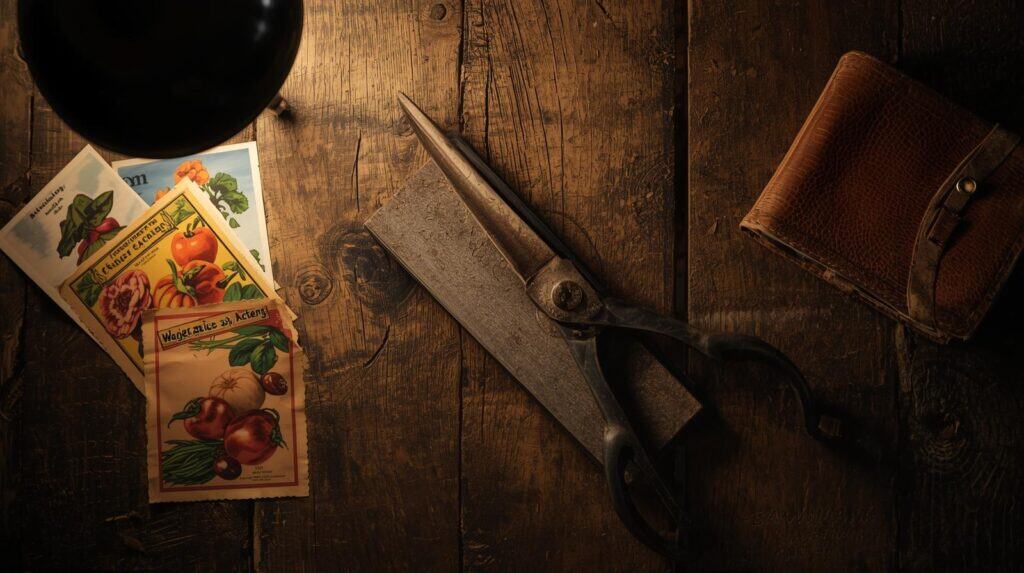
- It looks like maintenance. It looks like sharpening your tools. When I can’t garden, I’m in the shed sharpening my hoes and oiling my shears. Are you sharpening your skills during this downtime? Or are you just whining about the lack of harvest?
- It looks like studying. I read seed catalogs and study soil composition in January. Are you studying Scripture? Are you learning about the industry you want to lead?
- It looks like prepping the soil. You pray when it feels dry. You show up to church when you don’t feel “fed.” You serve when nobody notices. You tithe when the budget is tight.
This is quiet work. This is invisible obedience. And let me tell you, this is where real faith is built. Anybody can shout “Hallelujah” when the harvest is coming in. It takes a seasoned disciple to whisper “Thy will be done” in the middle of a bleak, freezing Spiritual Winter.
Navigating the Frost
I remember a few years ago, I had a peach tree that just refused to bloom. I was ready to rip it out. I stood there with my axe, channeling the parable of the barren fig tree a little too literally. But an old timer in the community told me, “Leave it. It just had a hard winter. It’s resetting.”
I left it. The next year? It nearly broke its own branches with the weight of the fruit.
You might feel like that tree. You feel like you are taking up space. You feel like you are in a perpetual Spiritual Winter while everyone else is enjoying an endless summer of success.
Don’t curse the cold. Don’t resent the silence. And for the love of all that is holy, put down the shovel and stop digging up your seeds.
Trust the Gardener. He knows what time it is. He knows what zone you are planted in. He knows exactly how many chill hours you need before you are ready to bear the weight of glory.
Spring is coming. I promise you, it is coming. But spring is only for those who respect the Spiritual Winter.
FAQ: The Theology of Winter
Q: How do I know if I am in a Spiritual Winter or if I have just backslidden?
A: That is a great question. A Spiritual Winter usually involves a sense of dryness despite your obedience. You are doing the right things, but not seeing results. Backsliding involves wilful disobedience. If you are ignoring God, that’s not winter; that’s just rebellion. Read Desiring God’s take on spiritual darkness for more nuance on this.
Q: Can I shorten my Spiritual Winter?
A: Ha! I wish. You can certainly lengthen it by complaining and trying to force your way out of it (think of the Israelites doing laps in the desert). But you generally cannot shorten it. The season lasts as long as it takes for the work to be done.
Q: What should I pray during a Spiritual Winter?
A: Stop praying for the harvest. Start praying for the roots. Pray for endurance. Pray for character. Pray that God won’t lift the frost until the pestilence in your heart is dead.
Q: Is it wrong to be frustrated during a Spiritual Winter?
A: No, it’s human. Read the Psalms. David spent half his life in a Spiritual Winter, complaining to God about it. It’s okay to be honest about the cold; just don’t set up camp there and refuse to believe in the sun.
Q: Does a Spiritual Winter mean God is angry with me?
A: Almost certainly not. Pruning is not punishment. As GotQuestions.org explains, the Vinedresser prunes the branches that are bearing fruit so they will bear more fruit. If you are being cut back, it’s likely because you are valuable, not because you are hated.
Continue the Journey
If this message about winter seasons spoke to you, these posts go even deeper:
Faith and Craftsmanship: Why God Cares How You Build Your Life
Discover how craftsmanship mirrors discipleship, why process matters more than speed, and how God shapes us through patient, intentional work.
→ Read it on The Midlife Disciple
Why God Allows Wilderness Seasons A Biblical Guide for Men in Transition
From Adventure Wiser, this companion piece explores why God leads men into uncomfortable seasons and how the wilderness refines, strengthens, and prepares us for what’s next.
→ Read it on Adventure Wiser
Adam Kesterson is the founder of The Midlife Disciple, a blog exploring the intersection of faith, woodworking, and the second half of life. When he isn’t writing, he is likely freezing in his workshop in Mena, Arkansas, or yelling at his tomato plants to grow faster.