
Midlife sneaks up on you. One day you’re young, reckless, and think a “joint” is something purely medical or recreational. Next thing you know, you’re in your garage in Mena, Arkansas, comparing parallel clamps like they’re crypto investments and wondering if your lower back is ever going to forgive you for lifting that sheet of plywood.
Somewhere between the sore knees, the better coffee, and the constant hum of my RIKON bandsaw, I discovered something profound. I found woodworking faith lessons hidden in the sawdust. Not the Instagram-perfect, influencer-style woodworking where everyone has a clean apron, a sponsorship, and hands that look like they’ve never touched manual labor. I’m talking about the dusty, crooked, “why-is-this-still-not-square” reality.
And somewhere between the noise of the dust extractor and the silence of the stain drying… God met me there.
The Workshop Became My Sanctuary (and My Confessional)
My garage isn’t holy ground, but it feels close. In a world that screams for attention—emails, texts, news feeds, demands—the shop is a fortress of solitude. No phone (unless I’m Googling why my router bit is burning the maple). No notifications. Just wood, tools, and quiet.
In that stillness, my prayers changed. They stopped being fancy, “theological” prayers recited from memory and became real ones.
“Lord, why won’t this Domino joint line up?”
“Also… while we’re chatting… why won’t my life?”
Funny thing is, God answers both. Usually with silence, which forces me to look closer at the grain. This is where woodworking faith lessons collide with real life.
Did you know that men who engage in “tactile hobbies” report a 34% decrease in stress-related cortisol levels? It turns out, using your hands to build something isn’t just a hobby; it’s a neurological reset button. For Christian men navigating the midlife slump, these woodworking faith lessons are cheaper than therapy and yield better furniture.
But it’s more than just stress relief. It’s revelation. When you shape a physical material, you begin to understand the One who shaped you. You realize that you are just a rough board in the Master’s shop, and He isn’t done planing you down yet.
Woodworking Faith Lessons #1: Patience is Painful (The Moisture Content of the Soul)
Wood has grain. Ignore it, and it splits. Fight it, and it warps. Treat it like it’s plastic, and it will humble you immediately.
Sound familiar?
I spent the first half of my life forcing my own plans. Rushing God’s timing. Ignoring His direction because I thought I was the master carpenter of my own destiny. I wanted the finish line without the sanding. I wanted the platform without the preparation.
One of the hardest woodworking faith lessons I had to learn was that you cannot rush the acclimation process. If you bring a board into the shop and cut it immediately, it will move. It will twist. It needs time to adjust to the environment. My soul was the same way. God taught me surrender through the grain of a walnut board.
The “Patience vs. Panic” Matrix
| Scenario | The Rookie Reaction | The Midlife Disciple Reaction | Woodworking Faith Lessons Applied |
| The Glue-Up | “Clamp it tighter until it screams!” | “Gentle pressure. Let the glue do the work.” | Force creates tension; trust creates a bond. |
| The Mistake | “Throw it across the room.” | “Sigh. Grab the off-cut bin. Start over.” | Anger solves nothing. Repentance fixes everything. |
| The Finish | “One thick coat to save time.” | “Four thin coats, sanded in between.” | Sanctification is a slow process, not a spray tan. |
| The Design | “Wing it and hope for the best.” | “Measure twice, pray once, cut once.” | Preparation prevents desperation. |
These woodworking faith lessons remind us that spiritual maturity, like a good finish, cannot be rushed without ruining the product. You can’t microwave character. It has to be slow-cooked.
Woodworking Faith Lessons #2: You Can’t Build Alone (The Theology of Clamps)
There is an old joke in the woodworking world: “You can never have enough clamps.”
It’s funny because it’s true. You think you have enough, and then you start a complex glue-up, and suddenly you are shouting for a spouse, a neighbor, or a passing stranger to hold a corner.
This leads to one of the most vital woodworking faith lessons: Self-sufficiency is a myth.
We like to think of ourselves as “Lone Wolf” Christians. Just me and my Bible. Just me and my shop. But try to glue up a dining room table by yourself. You will end up with a crooked table and a lot of glue on your shirt. You need pressure from multiple angles to keep things straight.
The Spiritual Clamp Comparison
- Parallel Clamps: These are your close friends. They apply strong, even pressure. They keep you square when you want to twist.
- Spring Clamps: These are the casual encouragers. They hold the small things together while the glue sets.
- Pipe Clamps: These are the mentors. Heavy, ugly, sometimes hard to adjust, but they provide the massive force needed to close the biggest gaps in your life.
If you don’t have “spiritual clamps” in your life—men who will press you, hold you accountable, and keep you from warping—you will fall apart when the pressure comes. These woodworking faith lessons taught me that community isn’t optional; it’s structural.
Woodworking Faith Lessons #3: Mistakes Don’t Disqualify You (The Theology of Filler)
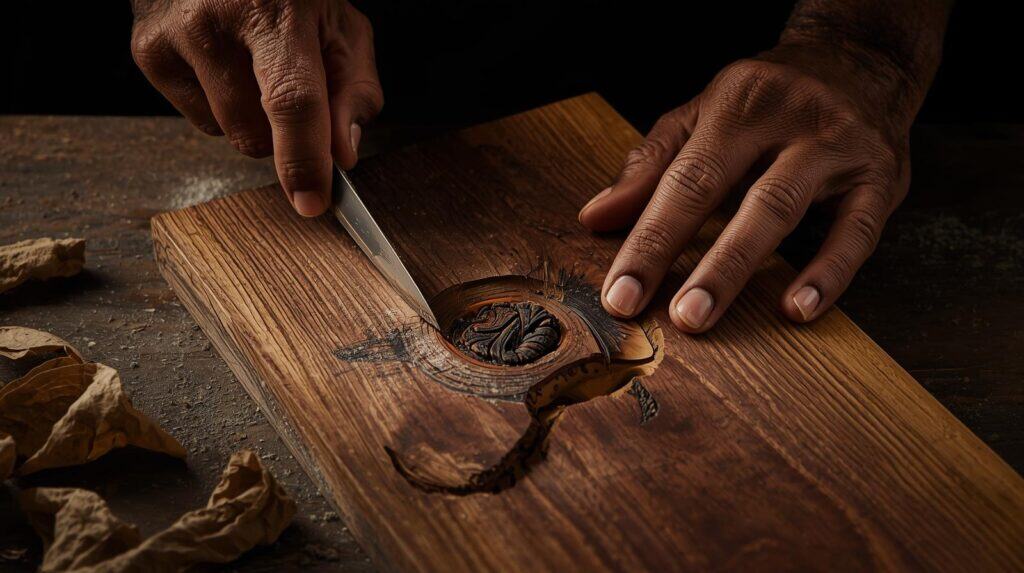
Every project has them: bad cuts, wrong measurements, and holes drilled on the “show” side.
I remember working on a custom sign recently. I was using the laser engraver, and I miscalculated the center point. The text was off by half an inch. In my early days, that mistake meant the project was trash. I’d toss it in the burn pile and sulk for the rest of the afternoon.
But the more I learned woodworking faith lessons, the more I understood the concept of redemption.
You don’t always throw the table away because of a knot. You fill it with epoxy. You embrace the defect. You sand it down until the flaw becomes a feature. Sometimes, you cut the board shorter and make a smaller, better table.
Grace works the same way. God doesn’t scrap you when you fail. He reshapes you. He takes the “knots” of your past—the failures, the scars, the liver transplants, the lost years—and he pours grace into them until they become the strongest part of your character.
Redemption smells a lot like sawdust.
According to a study on the “Maker Movement,” over 60% of DIYers say that repairing an item gives them a greater sense of satisfaction than buying a new one. Why? Because there is a story in the repair. These woodworking faith lessons teach us that we are valuable because of the work the Master has put into fixing us, not because we were perfect raw material.
Woodworking Faith Lessons #4: Craftsmanship Is Worship (The Avodah Principle)
The Bible is pretty clear on this. Colossians 3:23 says, “Whatever you do, work at it with all your heart, as working for the Lord.”
The Hebrew word for work, avodah, is the same word used for worship. Think about that. There is no separation between the “sacred” singing in church and the “secular” sanding in the garage.
One of the most transformative woodworking faith lessons is realizing that sanding a table leg can be an act of worship if done with a heart of excellence.
So I stopped rushing.
- No shortcuts.
- No “good enough for government work.”
- No hiding mistakes with caulk (well, mostly).
- No ignoring the back of the cabinet just because “no one will see it.”
God sees it.
Every smooth edge became a prayer. Every tight dovetail became praise. When we pursue woodworking faith lessons, we realize that excellence is a reflection of God’s character. He didn’t build a “good enough” sunrise. He didn’t create a “mostly functioning” universe. He built it good. As His image-bearers, we should try to do the same.
Woodworking Faith Lessons #5: Discernment is Knowing Your Tools
I love tools. I admit it. I have the Festool Domino, and yes, it was worth every penny. I have the dust extractor because I value my lungs.
But having the tool and knowing the tool are two different things. You can use a chisel as a screwdriver, but you’ll ruin the chisel and strip the screw.
One of the subtle woodworking faith lessons is discernment. It’s knowing which tool to pull from the spiritual toolbox.
- Sometimes you need the Sledgehammer (Hard truth, confrontation).
- Sometimes you need the Block Plane (Gentle correction, shaving off tiny inconsistencies).
- Sometimes you need the Sandpaper (Time, friction, and patience to smooth out a rough relationship).
If you treat every problem like a nail, you’ll just hammer everything in your life to death. Woodworking faith lessons teach us to ask: “Lord, what is the right tool for this situation? Do I need to cut this out of my life, or do I just need to sand it smooth?”
Why Midlife Is the Best Season for Woodworking Faith Lessons
At 20, I wanted success.
At 30, I wanted status.
At 50, I want meaning.
The “U-Curve of Happiness” suggests that satisfaction dips in midlife but rises again as we shift our focus from ambition to legacy. This is why woodworking faith lessons hit so hard right now. Woodworking slows you down. Faith anchors you.
Midlife isn’t a crisis; it’s a calling. It is a season to build:
- Character (through patience)
- Legacy (through heirloom projects that will outlast you)
- Relationships (making things for others rather than buying them)
- Faith (through silence, prayer, and the discipline of the shop)
These woodworking faith lessons are the curriculum for the second half of life. We aren’t just making furniture; we are making men. We are moving from the “Resume Virtues” (skills you bring to the marketplace) to the “Eulogy Virtues” (character they talk about at your funeral).
Final Thoughts: God Loves Unfinished Projects
If you take away any of these woodworking faith lessons, let it be this: God doesn’t need your perfection. He wants your presence.
So bring Him your crooked boards. Bring Him your messy past. Bring Him your unfinished edges. He specializes in restoration. He is the original Carpenter, after all. He knows exactly where the knots are, and He knows exactly how to work around them to make something beautiful.
If you want to dig deeper into woodworking faith lessons, don’t just read about them. Go buy a saw. Make some dust. And if you meet Him in your workshop? Even better.
FAQ: Woodworking Faith Lessons
Q: Can I really learn spiritual truths from a table saw?
A: Absolutely. Just like Jesus used farming parables, woodworking faith lessons use the physical world to explain spiritual truths. Plus, a table saw teaches you the fear of the Lord (and the fear of kickback) very quickly. It demands respect, just like holiness does.
Q: I’m not handy. Are these woodworking faith lessons still for me?
A: Yes. You don’t need a Festool Domino or a fancy shop to understand woodworking faith lessons. The principles of patience, planning, and redemption apply whether you are building a cabinet or building a spreadsheet. The medium changes, but the Master remains the same.
Q: Where can I find more resources on Christian woodworking?
A: There is a growing community of makers who focus on woodworking faith lessons. Check out local maker spaces or online forums dedicated to Christian craftsmanship. Look for the guys who are more interested in serving than showing off.
Q: How do I start applying woodworking faith lessons if I don’t have a shop?
A: Start with what you have. Repair something in your house. Taking care of what you own is the first step in stewardship, which is one of the core woodworking faith lessons. Fix a leaky faucet. Paint a room. Reclaim dominion over your physical space.
Q: Why do you repeat “woodworking faith lessons” so much?
A: Because in woodworking, repetition is the mother of skill. Also, Google likes it. But mostly, it’s because I really want you to remember these woodworking faith lessons. If you don’t sand with the grain, you see the scratches. If you don’t preach the truth repeatedly, you forget it.