
Daily Bible Reading Habit: How to Build the Habit When Nothing Else Has Stuck in 2027

Most plans don’t survive a bad month. The habit has to be able to.
There was a stretch a few years back when I sat at my kitchen table every morning not because I felt spiritual, but because a doctor had just told me I had liver cancer.
He was wrong. It took a few weeks and a second set of scans to find that out, and I spent every one of those mornings at that table with coffee going cold and a daily Bible reading habit I hadn’t had before. I didn’t start it because I finally found the right plan. I started it because I was scared, and it was the thing that was there.
That’s not a tidy origin story. It’s the real one.
What Daily Bible Reading Actually Is
Strip away the plans, the apps, the 66-books-in-a-year charts, and daily Bible reading is just this: you open the book, most days, for a while. That’s the whole practice.
It gets sold with more machinery than that — reading plans with checkboxes, sermon-style breakdowns, seven-step “quiet time” systems. Some of that helps some men. None of it is the thing itself. The thing itself is older and plainer than all of it: sit down, read, let it work on you.
Men my age tend to approach it the way we approach everything else that matters — like it needs a system before it can start. It doesn’t. A system can help later, once the habit is already load-bearing. Before that, a system is usually just one more thing to fail at.
This site has already covered spiritual discipline broadly — fasting, solitude, journaling, and accountability as a set. This post narrows in on the one discipline underneath most of the others: actually opening the book.
Why This Is Worth the Trouble
A few honest reasons, not the inspirational-poster version:
- It gives the day a fixed point before the day gets to set the terms.
- It’s the one place a lot of men our age get told the truth about themselves without an agenda attached.
- It’s cumulative. A single morning in the Word doesn’t do much. Years of mornings add up to something you can feel even when you can’t point to the exact mechanism.
Paul told Timothy that all Scripture is God-breathed and is useful for teaching, rebuking, correcting and training in righteousness, so that the servant of God may be thoroughly equipped for every good work (2 Timothy 3:16-17, NIV). That’s not a promise that reading fixes a man. It’s a claim that the text itself does work on the reader over time, if the reader keeps showing up to it.
Here’s the part I won’t dress up: this habit hasn’t erased every struggle I carry. I still deal with the pull toward pornography — less than I used to, a lot less, but “less” isn’t “gone,” and I’m not going to write it like it is. What’s changed isn’t that the fight disappeared. It’s that it doesn’t run the show the way it used to. If you’re a man reading this waiting to feel finished with something before you’re allowed to call your faith real, you’re waiting on a standard the Bible itself doesn’t set.
Struggle isn’t proof you’re doing this wrong. Staying anchored under pressure like that is its own post — the short version is that the anchoring has to happen before the pressure hits, not during it.
How to Read Scripture Daily When Nothing Else Has Stuck
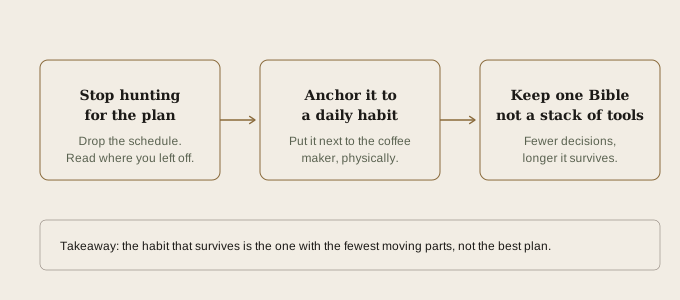
I have ADHD. I’ve started more reading plans than I can count and finished almost none of them. Somewhere along the way I stopped trying to fix that and started building around it instead. What’s actually worked is smaller than any plan I ever abandoned.
- Stop hunting for the plan that finally works
- Anchor it to something you already do every day
- Keep one Bible, not a stack of tools
Stop hunting for the plan that finally works
Every reading plan I’ve started assumes a version of me that doesn’t miss days. I’m not that guy, and neither are most men I know. The plan isn’t the problem — the expectation that a plan will hold your attention for you is. Drop the plan. Pick up the book. Read where you left off, or read wherever it falls open, and go from there. No schedule to fall behind on means no schedule to quit.
Anchor it to something you already do every day

The habit that survives isn’t the one with the best content — it’s the one attached to something you were already going to do. Coffee, first thing after the alarm, before the truck starts: pick the anchor that’s already locked into your day and put the Bible next to it, physically, so the two actions are hard to separate.
Keep one Bible, not a stack of tools
I read from an NIV study Bible with Charles Stanley’s notes in the margins. Not because it’s the only good one — because it’s the one. When I hit a verse I can’t make sense of on my own, the note is right there instead of a half-hour rabbit hole on my phone that ends with me reading something else entirely. One book, in one place, that you always reach for. The fewer decisions the habit requires, the longer it survives.
Your word is a lamp for my feet, a light on my path. — Psalm 119:105, NIV
That’s the scale this operates on. Not a floodlight for the whole road. A lamp, for the next few steps. Some mornings that’s all you get, and it’s enough.
What Usually Goes Wrong

- Treating a missed week as a failed habit. It’s not a streak. Missing three days and reading on the fourth is the habit working, not the habit broken.
- Switching translations or Bibles looking for the one that finally clicks. Most of what stalls men out isn’t the translation. It’s the searching itself, which becomes its own way of avoiding the sitting-down part.
- Turning it into a task to clear before the day counts as started. The moment it becomes a box to check, it starts competing with every other box, and it’s an easy one to skip when the morning’s already behind.
- Waiting to feel ready. Most mornings I didn’t feel anything close to ready. The habit isn’t built on the mornings you feel it. It’s built on the mornings you don’t and show up anyway.
If This Doesn’t Fit Your Life
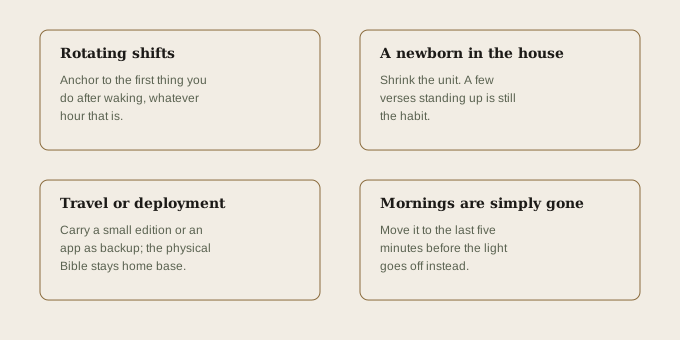
A fixed morning routine doesn’t survive shift work, a newborn, a deployment, or a season where your schedule isn’t yours. A man in one of those seasons isn’t failing at this — he needs a different shape of the same habit.
- Rotating or unpredictable shifts: anchor to the first thing you do after you wake, whatever hour that is, instead of a clock time.
- A season with a new baby in the house: shrink the unit. A few verses, standing up, is still the habit. Length isn’t the point.
- Travel or deployment: carry a small edition or a phone app as the backup, and treat the physical Bible as home base you return to.
- A season where mornings are simply gone: move it to the last five minutes before you turn off the light instead of forcing a slot that keeps failing you.
None of these are lesser versions of the practice. They’re the same practice, sized to the life you’re actually living instead of the one the plan assumed.
Frequently Asked Questions
Do I need to read the whole Bible in a year to count this as a real habit? No. A year-long reading plan is one shape this can take, not a requirement. Reading most days, in whatever amount you can sustain, is the habit. The full-Bible-in-a-year plan is a tool some men use inside that habit — it isn’t the habit itself.
What translation should I use? Whichever one you’ll actually keep reading. This post uses the NIV throughout because that’s the translation I read and the one this site uses. If a study Bible with notes helps you understand what you’re reading, that’s a real advantage, not a crutch.
What if I read and nothing seems to land? Some mornings won’t land, and that’s not a signal to quit. The value here is cumulative, not per-session. Keep the habit and let the individual mornings be inconsistent.
Is it wrong to use a study Bible instead of reading it “raw”? No. Study notes exist because understanding ancient text written for a different culture is genuinely hard. Using help isn’t cheating the practice.
How long should I actually read each morning? Long enough to be honest, short enough to be sustainable. Ten unhurried minutes you keep doing beats forty inspired minutes you do twice and abandon.
Does this fix the stuff I’m actually struggling with? Not on its own, and not on a schedule. It’s one discipline among several a man needs — this site’s Brotherhood and accountability side matters here too. Treat daily Scripture reading as one part of the work, not the whole of it.
I have ADHD and every routine I’ve built has fallen apart within a few weeks. Is this actually different? It’s built for that specifically, not despite it. The failure point for most routines is complexity — steps, sequence, a plan to remember. This has one moving part: a book next to something you already do daily. Fewer decisions means fewer places for the habit to break.
Wrapping Up

I didn’t start this because I had it figured out. I started it scared, at a kitchen table, waiting on test results. Years later I still don’t have it figured out — I still miss mornings, I still carry a fight I haven’t fully won — but I haven’t stopped showing up to the book, and that’s turned out to matter more than getting it right.
Pick your anchor today. Not next Monday, not after you find the plan. Tomorrow morning, put the Bible next to the coffee maker before you go to bed tonight, and open it when you reach for the coffee. That’s the whole first step.
Scripture quotations taken from The Holy Bible, New International Version®, NIV®. Copyright © 1973, 1978, 1984, 2011 by Biblica, Inc.™ Used by permission. All rights reserved worldwide.